Best Packaging 2026: the Partnership between NATIVIA® and Corapack Redefines HORECA Packaging
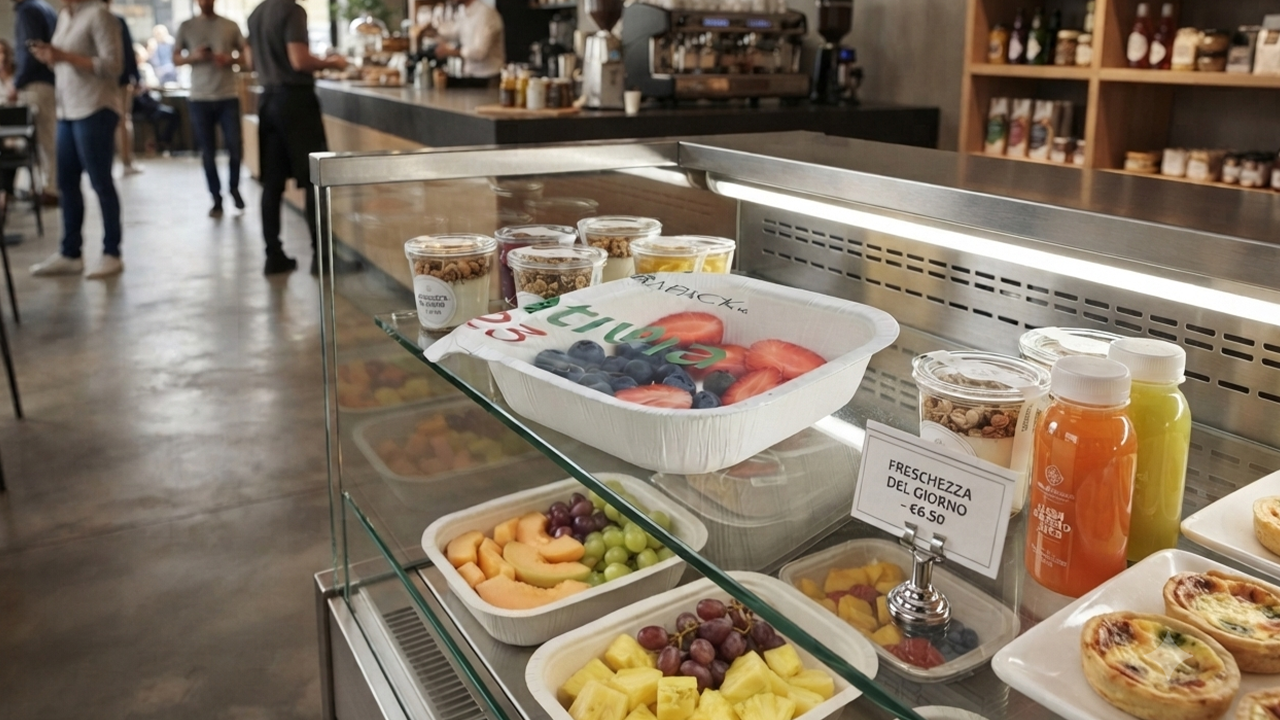
Food-contaminated packaging remains one of the most persistent barriers to effective waste sorting, particularly in the HORECA sector, where speed and hygiene leave little room for consumer effort. Taghleef Industries addresses this challenge with a sealing top lid for moulded pulp trays, built on NATIVIA® D823, the world’s first BoPBSA film designed for home compostability. The result is a packaging structure that removes the sorting step entirely, without compromising on transparency, barrier performance or line compatibility.
Product overview. Sealing top lid for moulded pulp trays made from NATIVIA® PBSA-based film, fully designed for home compostability. Ideal for the HORECA sector, it eliminates the need to separate food-contaminated waste, ensuring food safety and product visibility.
Innovation. This solution features NATIVIA® D823, the world’s first BoPBSA film developed for domestic compostability. The material provides high sealing integrity, balancing transparency, grease barrier, and breathability. It allows the entire packaging to be disposed of in the organic waste stream.
Materials used. The top lid is made from bioriented NATIVIA® D823 PBSA-based film. Selected for its technical performance, it adheres perfectly to lacquered paper trays thanks to a very low sealing temperature, making it compatible with high-speed industrial lines. The material is bio-based and designed for full organic waste disposal, eliminating the need for manual separation of components and simplifying the management of food-contaminated packaging.
Technologies. The core technology is sequential biaxial orientation, which gives the BoPBSA film excellent mechanical properties. For converting, a high-integrity heat-sealing technology has been developed, featuring an exceptionally low sealing starting temperature. This allows the material to run on existing high-speed packaging lines without structural modifications, enabling a fast transition to sustainable solutions.
Environmental benefits. This solution replaces fossil-based plastics with bio-based materials (moulded pulp and BoPBSA), reducing dependence on non-renewable resources. Its key innovation is the design for full home compostability, overcoming limitations associated with scarce industrial composting facilities and allowing the entire packaging to be disposed of in the organic stream even when contaminated with food residues.
Benefits for end users. This solution transforms the user experience in the HORECA and fresh produce sectors through a design fully optimised for home compostability. Consumers can dispose of the entire packaging in organic waste without separating materials or cleaning food residues. Food safety is ensured by PFAS-free components, while the transparent NATIVIA® D823 film allows verification of product freshness, outperforming traditional paper-only packaging. The structure is highly versatile, heat-resistant for ready meals, and breathable to prevent moisture build-up in fresh produce.
Communication advantages. The solution simplifies consumer communication by redefining the post-consumption experience: home compostability removes any uncertainty regarding disposal, allowing the entire soiled packaging to be disposed of in organic waste. In the HORECA sector, NATIVIA® film transparency ensures direct visual contact with product freshness, surpassing the limitations of paper-only solutions. This approach positions the company as an early adopter of the PPWR regulation, demonstrating a tangible environmental commitment in both B2B and end-user contexts.
As the packaging industry evolves to meet PPWR requirements, solutions that simplify end-of-life disposal while maintaining food safety and shelf appeal will become increasingly central to product development. This NATIVIA® D823 solution, a finalist at the latest edition of Best Packaging 2026 organized by Istituto Italiano dell’Imballaggio, offers converters and brand owners a way to make this transition now, using existing high-speed lines and without asking consumers to change their behavior. For both HORECA operators and fresh produce brands, it represents a practical and implementation-ready step towards fully compostable packaging.